 GC-BOB


product search
Other AccessoriesIIotpressure GaugeFlow MeterPressure Gauge SeriesThermometer Series
search

The core logic of a bimetallic thermometer: through a bimetallic strip, directly into thermal energy into mechanical displacement. This metal sheet is usually made up of two metals with very different physical properties (usually steel and brass) firmly welded together.
The cleverest part of this design is to take advantage of the difference in the expansion coefficient of the material. When the temperature rises, the speed of elongation of the two metals is not the same, and the uneven force will force the metal sheet to bend or curl. In industrial products, we will wind this piece of metal into a spiral spring. When the temperature changes, the spiral tube will twist, driving the middle shaft to rotate, and the pointer on the dial will point out the reading. This purely mechanical design does not require a power supply and is extremely durable. It has always been standard in the industry in pipelines, storage tanks and HVAC systems where electronic sensors (such as RTD) are easy to strike or appear overqualified.
This video explains the basic principle of how a bimetallic thermometer works:
To understand this thing, we must see through its material science underlying logic. The bimetallic strip is typically permanently bonded together by a layer of a high expansion metal, such as brass, and a layer of a low expansion metal, such as steel or an alloy.
Because each metal “reacts” differently to heat, one layer wants to grow faster when the temperature changes, but because it is stuck to the other layer, the result is that the whole sheet can only bend to the side with the lower expansion rate. This physical displacement is the first step in converting invisible heat into a measurable signal.
Although straight metal sheets can also show temperature changes, industrial scenarios require high precision and volume. In order to achieve high sensitivity in a small probe space, manufacturers will wind the bimetallic strip into a spiral coil (similar to a spring).
As the temperature rises, the torque caused by the inconsistent expansion of the two metals will tighten or relax the entire coil. This “twisting” effect is crucial, it can produce enough rotational force. The best thing about this design is that it can stuff a long piece of metal into a thin probe, which not only ensures the measuring range, but also does not make the equipment bloated.
The most reassuring part of the bimetal thermometer is its full mechanical transmission. One end of the spiral coil is fixed at the bottom of the probe, and the other end is directly connected to the center axis of the pointer.
Because there are no electronic components involved in the middle, the movement of the pointer is very smooth and continuous, with almost no lag feeling common to digital processing.
This physical expansion principle gives it several hard-core advantages that electronic sensors (such as thermocouples) cannot match:
Because this structure is extremely resistant, it has become the first choice in many key areas:
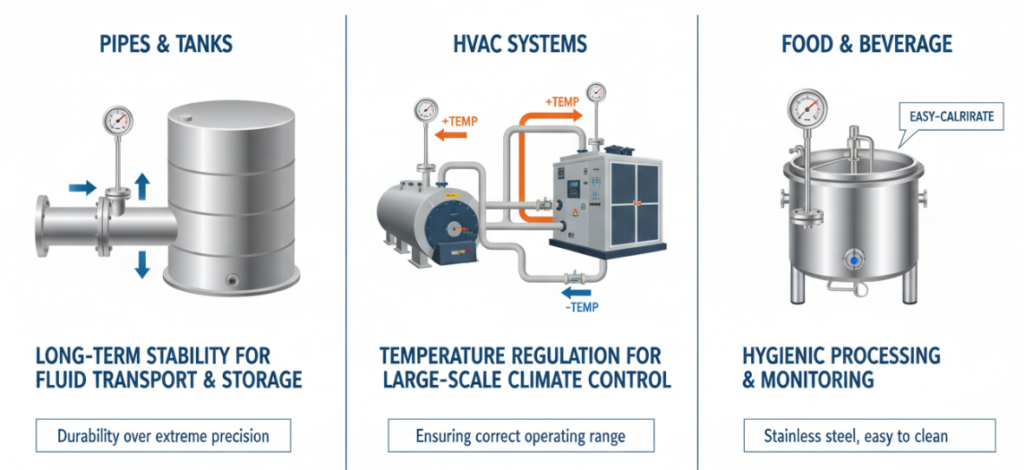
In the final analysis, bimetallic thermometers rely on highly predictive physical laws, rather than high and low electrical signals. This is why today, with such a high degree of automation, it is still an indispensable cornerstone of modern industrial dashboards.
Author: David S. Miller
“I’m a mechanical engineer with over 12 years of experience in industrial process instrumentation. Throughout my career, I have designed and calibrated thermal monitoring systems for complex HVAC and pipeline infrastructures. I am passionate about the ‘elegant simplicity’ of mechanical sensors; while digital technology evolves, the physics-based reliability of the bimetallic thermometer remains a cornerstone of industrial safety. I wrote this guide to help engineers and technicians understand the precise material science that makes these rugged tools so indispensable in the field.”