 GC-BOB


product search
Other AccessoriesIIotpressure GaugeFlow MeterPressure Gauge SeriesThermometer Series
search

The accuracy of a bimetallic thermometer typically falls within ±1% to ±2% of the full-scale range, specifically when conforming to ASME B40.3 Grade A (±1%) or Grade B (±2%) standards. To achieve this rated precision in the field, you must ensure the stem is immersed at least 2 inches (50mm) in liquids or 4 inches (100mm) in gases to prevent “stem conduction error” where the ambient temperature leaks into the reading. It is critical to understand that while these instruments are highly durable for constant monitoring in ducts or pipes, they are mechanical devices subject to “calibration drift” caused by vibration or mechanical shock. Therefore, their accuracy is only as reliable as your last calibration check; they require regular zero-point verification using the external reset nut to maintain professional-grade precision.
When choosing a model, the accuracy level is calculated based on the “full scale”, not the current reading.
The safest thing to do is to let your target measure the temperature in the middle 1/3 area of the dial. If you measure in this interval, the accuracy performance is often the best.
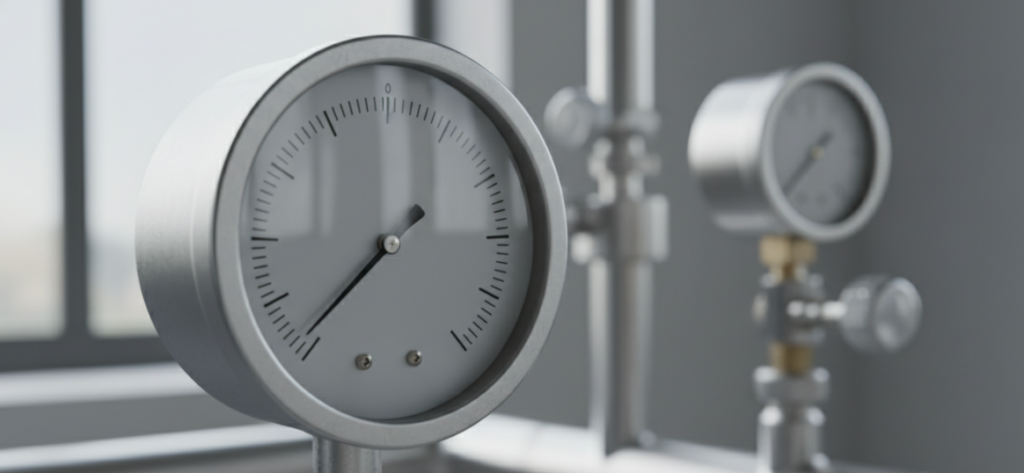
Even if you buy the world’s top thermometer, if the installation is not in place, the measured data is still garbled. The temperature sensing element of the bimetallic thermometer is a piece of metal spring coil, which is hidden at the tip of the probe rod. In order not to let the ambient temperature interfere with the reading, you must ensure sufficient insertion depth:
If this principle is not followed, the so-called “rod conduction error” will occur “. To put it bluntly, the cold and heat of the external environment “slipped” along the metal pole, causing the reading to be higher or lower than the actual process temperature.
Bimetal thermometers are all driven by mechanical structure. Although they are more solid than electronic sensors, they are also more afraid of toss.

I think the most humane thing about this instrument is its “maintainability”. Professional-grade models have an external reset nut on the back.
I strongly recommend doing an “ice water bath test” on a regular basis: insert a pole into the prepared ice water mixture and see if the pointer points to 32 °F (0°C). If it is off, don’t hesitate to use a wrench to turn the reset nut back. This is much more cost-effective than scrapping and replacing, and it also ensures that your instrument is always maintained at a professional level of accuracy.
Author : Marcus Thorne
“I am an instrumentation specialist with over a decade of experience in industrial thermal systems. Throughout my career, I have focused on the precision and reliability of mechanical measurement tools. My expertise lies in helping engineers navigate ASME standards and implement rigorous calibration protocols. I wrote this guide to share practical insights on maintaining bimetallic thermometer accuracy and preventing common field errors like stem conduction.”