 GC-BOB


product search
Other AccessoriesIIotpressure GaugeFlow MeterPressure Gauge SeriesThermometer Series
search

When it comes to keeping the pool clean and clear, few components are more important than the pool filter pressure gauge, but they are often overlooked. This small circular dial at the top of the canister may look inconspicuous, but it is one of the most useful tools for understanding the performance of a filtration system. Whether you are new to the pool or an experienced technician, learning to read and interpret pressure gauges correctly can save you time, money, and many setbacks. In this guide, we will take you through everything you need to know-from the function and working principle of the pool filter pressure gauge, to how to troubleshoot too high or too low readings, and the best to keep the system running smoothly Maintenance method.

The pressure gauge is used to tell you that the swimming pool filtration system is “blocked. It measures the resistance of water as it passes through the filter. If the filter is dirty, the resistance is high and the pressure gauge reading is high. It’s like an oil gauge and a water temperature gauge on a car, you can see how the system is running right now. Looking at it in time can save you a lot of trouble.
The structure of the pressure gauge is very simple, with a dial, pointer, and an interface attached to the back, which is directly screwed on the filter. It works by sensing the water pressure inside the filter. When the water flow through the filter, if the filter is blocked by dirt, the water flow will be subject to greater resistance, resulting in an increase in the internal pressure of the filter. This elevated pressure will be transferred to the Bourdon tube or diaphragm inside the pressure gauge through the connection port, and then drive the pointer to deflect and display the current pressure value. I usually remember a “clean pressure.”
This pressure gauge on different types of filters, the installation position and function are basically the same, but the specific situation is still a little different.
Regardless of the filter type, the pressure gauge reading is about 7-10 PSI higher than the “clean pressure”, which usually means that cleaning is needed.
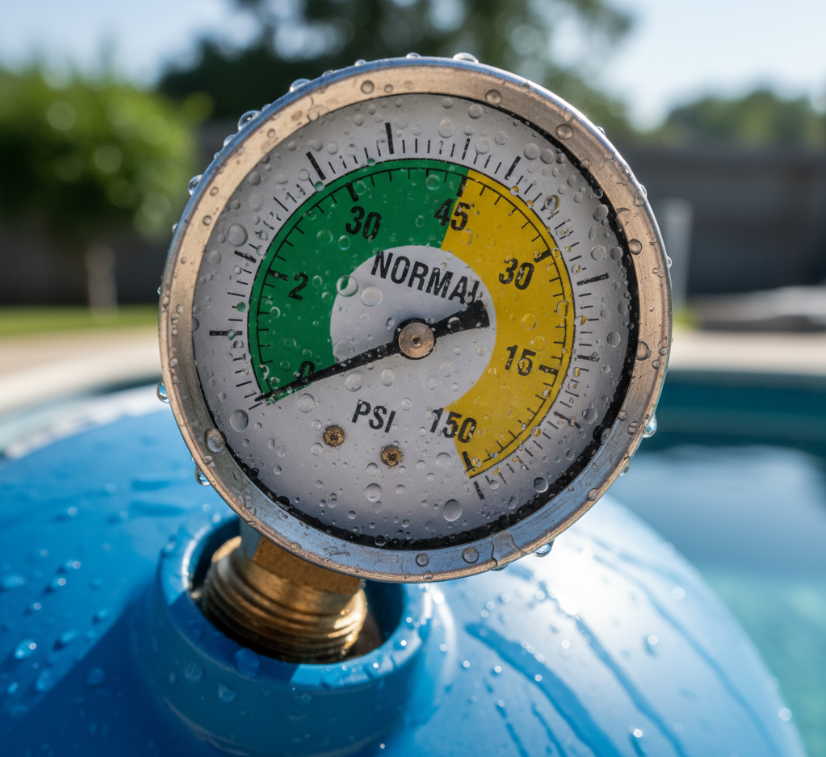
What should the filter pressure gauge point to be considered normal? This is actually a good question, but the answer is not a fixed number. It’s more like a dynamic scope that requires you to establish a “baseline”, which is what we often call “clean pressure”.
Every time I complete a thorough backwash or replace the filter, the first thing I do, and the most important thing, is to check and record the pressure reading at this time. The pressure at this time is the “initial pressure” or “clean pressure” of your filter in its cleanest state “. I always emphasize this step because it will be your “gold standard” for judging the condition of your filters in the future “.
You should do this: make sure the pump is running and the filter has just been cleaned. Let the system run for a few minutes, and then carefully observe the pressure gauge. For example, if the pressure gauge is stable at 10 PSI after my sand tank is backwashed, then 10 PSI is the clean pressure of this filter. I will write it on the waterproof label next to the device so that no matter who is maintaining it, it can be seen at a glance. This number is completely personalized and will be different for each pool system.
Once you have clean pressure, you can understand the normal operating range. As the filter captures impurities in the water, the filter material becomes progressively dirty and the resistance of the water to flow through increases, at which point you will find that the pointer on the pressure gauge begins to slowly rise.
Generally, when the pressure rises by about 7-10 PSI over yours “clean pressure”, it means that the filter is already quite dirty and needs to be washed or backwashed. For example, if your clean pressure is 10 PSI, then when the pressure reaches 17-20 PSI, it’s time to consider cleaning the filter.
I’ve seen lots of pools of different sizes and types. A large pool, with a high-power pump and a large filter, may have a clean pressure of only 5 PSI; while a small above-ground pool, with a limited pump power, may have a clean pressure of 15 PSI. So, what matters is relative change, not absolute value. If your system water pump is powerful, the filter size is small, the pressure may rise faster, or the normal operating range will be slightly different.
Accurate reading of the pressure gauge is the basis for judging the health of the filter.
Pool filter pressure gauges are usually circular dials. There will be a series of numbers on it, usually in PSI (pounds per square inch) or Bar. When you observe, make sure that your line of sight is parallel to the pointer of the pressure gauge and carefully look at the value pointed to by the pointer. Some dials also have color areas, such as green for normal, yellow for attention, and red for too high. But this is only the kind of auxiliary, the most accurate or read the specific value.
The most common mistake is “parallax”. If you look at the pressure gauge from the side, the position of the pointer may look higher or lower than it actually is. I always recommend aligning your eyes directly in front of the dial and observing the hands vertically. This is to get the most accurate readings.
Reading a pool pressure gauge is a bit like checking the tire pressure of a car. The principle is to measure pressure, but the judgment of the pool filter pressure gauge is much more complicated. We pursue a fixed value for car tire pressure, such as 32 PSI. And pool filter pressure, we focus on a “dynamic change” and “relative rise”. Its meaning is to indicate the degree of soiling inside the filter, rather than a fixed ideal value. By understanding this dynamic, you have mastered a key skill in pool maintenance.

When the pressure gauge reading of the pool filter rises abnormally, there are usually some obvious signs. The most direct is that the water flow is significantly smaller. At this time, the pool pump tends to emit more noise than usual, and even feels that the pump body temperature is too high, which is the signal that it is “overloaded”. In the long run, high pressure will not only lead to a sharp decline in filtration efficiency, so that the water quality of your swimming pool can not remain clear, what is more terrible is that it will cause serious structural damage to the entire filtration system.
What causes the filter pressure to be too high? In my opinion, there are mainly the following aspects:
This is the most common and most easily resolved reason. The working principle of the filter is to intercept impurities in the water. After a long time, these impurities will accumulate and block the filter medium, resulting in an increase in water flow resistance and the pressure will naturally go up.
The filter itself is fine, so you have to look at the pipeline.
The pump is the “heart” of the entire water circulation system “. If there is a problem with the pump itself, it may also cause abnormal pressure.
Sometimes, the problem is not in the filter system, but in the pressure gauge.
I usually bring a spare and calibrated pressure gauge. I’ll put my pressure gauge on it and compare the readings. If my watch reads normally, it means that the customer’s watch is broken and needs to be replaced.
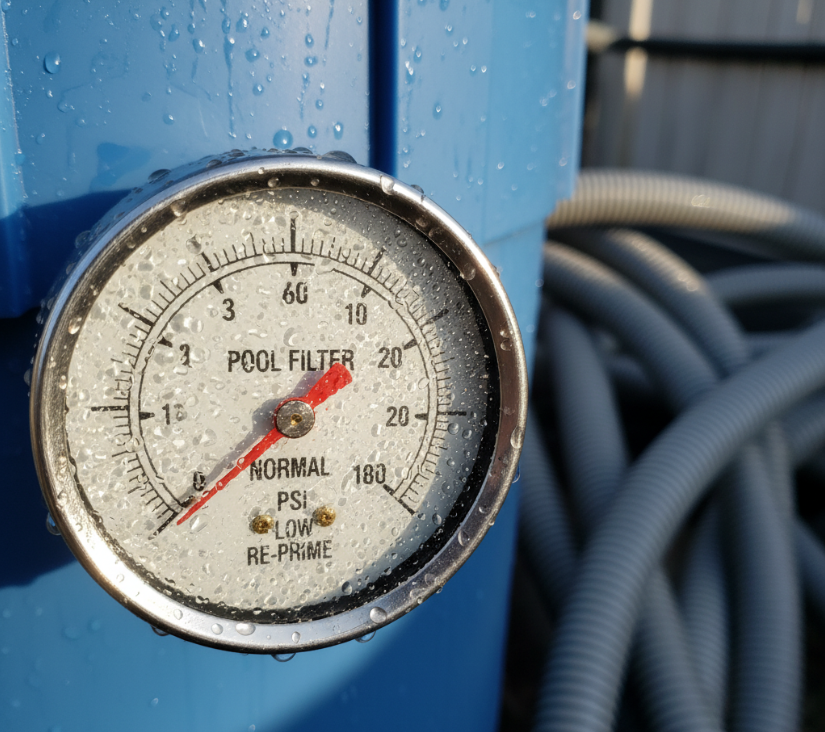
When you find that the pressure gauge reading of the pool filter is abnormally low, this is definitely a signal that requires immediate attention. Low pressure not only means that the filtration system is not working properly, it is more likely to cause damage to your pool equipment.
The most common manifestation of low pressure is insufficient pump suction. You will notice that the water flow in the swimming pool becomes slow, and the floating objects may increase on the originally clear water surface, and the water quality becomes unclean. More seriously, the continuous low pressure may cause the pump to idle.
The direct consequence of the pump idling is that the mechanical seal of the pump is damaged. Once the seal is damaged, water will penetrate into the pump motor, causing the motor to rust, or directly burning the motor.
What causes the pool filter pressure to be too low?
You need to carefully check whether the pump cover seal is aging or improperly installed, whether the drain plug is tightened, and whether all suction line joints are loose or cracked.
How to judge the air leakage on the suction side? A simple and effective method is to observe the pump basket. If there are a large number of small bubbles in the pump basket, it can be basically determined that the suction side is leaking.
If the pump cannot suck water smoothly, the pressure will naturally decrease.
This is a very intuitive reason. If the water level of the pool is lower than the suction port of the skimmer, the pump cannot absorb water normally.
After excluding all the above external factors, if the pressure is still too low, then the problem may be in the pump itself.
The most common is the impeller damage. Although the pump is running, you can hear its sound, but because the impeller is worn or broken, it cannot produce enough suction.
If you have checked all external factors and are sure that it is a problem inside the pump, I strongly recommend that you ask a professional to check or replace the pump. The repair of the pump involves expertise and tools, and blind operation may cause greater damage.

Check the pressure gauge into a habit.
This small action allows you to detect potential blockages, pump problems, and even damage to the inside of the filter.
The pressure gauge itself is also a consumable, and it will age with time and use. When will it need to be replaced?